Showing posts with label non-fiction. Show all posts

Monday, March 15, 2021

Untamed by Glennon Doyle


There are a lot of nuggets of wisdom in this book. A lot of insights into areas of life I should think about more. By sharing her own experiences and life lessons, Doyle prompts the reader to look inward. I liked that.

What was a little challenging for me was her tendency to speak in absolutes. Her words weren't should or could, or this worked for me, but rather a lot of musts made it into the story. I get that the book is a reflection of her passion, but there's no one-size-fits-all approach to life. And, I tend to prefer suggestions over mandates.

That said, it's impressive to read the sagacity one can arrive at upon true reflection. Doyle takes us into every corner of her life (and we go in deep) to understand how the willingness to face it all head on, and let it change us, saves us.

From finding her best life to fighting addiction to quelling the fears all parents have, Doyle does everything with power.

Part memoir, part motivational storytelling, the combination of content is emotional, thought-provoking and penetrating. There's no question Doyle sees both into herself and into her world. I appreciated her perspectives so much and got a lot out of this book. You might too.

Friday, December 20, 2019

The Big Oyster: History of the Half Shell by Mark Kurlansky

Second book club book #7

I'm getting a little ahead of myself for book club, but that's mostly because so many library books I have on hold are about to become available. It's a crazy cycle, but I'm so thankful for our public library system.

This book is nothing if not straightforward. Among recipes, famous first-hand experiences, and a slow move through history, we're treated to the life of the NYC oyster. Once a plentiful and popular food for the masses, this sad tale concludes with the oyster's departure. The driving force -- pseudo spoiler alert -- is pollution, and humanity's lack of foresight when it came to dumping just about anything categorized as waste into our waterways.

A thorough account, what's most interesting is that oysters have only been the decadent indulgence we know today for a short time. For a longer line in history, oysters were a food that united classes. It was just as easily stewed and placed on a poor family's table as it was served raw in a fancy, French-inspired restaurant. 

Beginning with colonization, man's connection to the oyster is tighter than you'd expect, so it's interesting to learn more about the evolution of that relationship, narrowed down within one area, New York City. It also turns out, oysters are pretty fascinating creatures in their own right. Kurlansky does a good job of weaving unique oyster characteristics into the history of an emerging New York City.

It's an interesting journey for such a small animal and such a quick bite of food, so it's also an interesting read. But, if you're not a foodie, history buff, or New York enthusiast, it might not be the book for you. There were definite moments where you felt like you were reading a Melville novel, bogged down by the latin classifications for these shelled delights (only Melville does it with whales -- Thar she blows!) Overall, this was an enjoyable read, and I learned a lot about something I knew absolutely nothing about.

Wednesday, August 21, 2019

Becoming by Michelle Obama

I have to lower my expectations to say I really enjoyed this book. While they weren't insanely high, I've heard Michelle Obama speak. I've seen the way she acts. She was the first First Lady I ever felt connected to as a person. I find her to be a poised, intelligent, kind, and genuine person. She was an accessible public figure and she was and still is cool.

While a lot of these traits come through in the book, along with her inspiring commitment to some very important causes, I couldn't help but feel like she was talking out loud, in written format, rather than writing a book. This created a disjointed feeling in the narrative for me. Although the flow was chronological, sections within chapters didn't easily connect, and transitions were few and far between.

The best part is the book takes you through the dynamics of Michelle's entire life. You see how each stage added onto the previous to move her down her own path. Even though she eventually must ride as a passenger on the path of someone else, she quickly makes even that situation her own. I love how she refuses to do things the way people did them before. I like that she pushed the envelope in the name of normalcy and never traded her compassion and natural self for diplomacy. 

Given a deep look behind the curtain, it was nice how prominently the Obama kids and Michelle's family featured in the book, and how little Barack's own experiences made an appearance. I appreciate that Michelle kept things solely from her perspective. What I didn't love was that her story gets interrupted by forced flourishes of language, smilies, metaphors, etc. You suddenly feel like you're reading an editor's words and not the author's, whose straightforward approach to storytelling is distinctive. 

Aside from the writing issues, I'm glad I read this book. It's an inspiring story about a woman who found normal even with it was almost completely out of sight. It's about someone who took their position seriously in the world and used it to speak out about her own passions and help those people who touched her heart the most deeply. I loved her connection to groups of people whose collective voices weren't loud enough to make a big noise on their own. She made the noise with them and for them, and that's important.

I only wish it was written differently. Michelle is an engaging and dynamic speaker. On stage and in interviews she has impact, but I kept tripping over the narrative while reading her. I still do recommend this book since it's a unique life story, but be prepared for a looser connection between sections, and more telling than showing as you learn about this incredible woman.

Monday, May 30, 2016

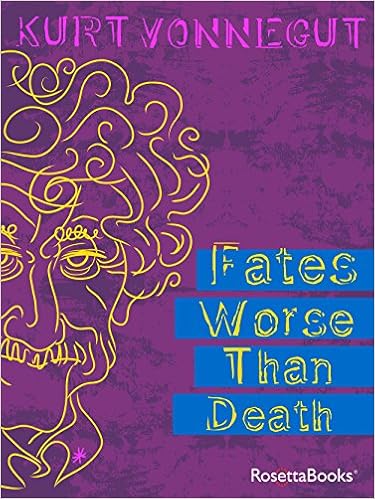
Fates Worse than Death by Kurt Vonnegut

Aside from reviewing this book, which is really nothing more than a collection of previously-published essays, I want to share how this book made me feel. 

I love Vonnegut. Sirens of Titan, Galapagos, and so many others are up there with my all-time favorites, so it was saddening to be told, by the author himself, that he just isn't invigorated by being a writer. It simply pays the bills and his books are so out there because he's clinically depressed. 

The essays are all over the place and are interesting enough - covering war, conservation, bits of Vonnegut's own life - all the biggies that appear in his fiction. He really has been around long enough to have met everybody. His name-dropping throughout surprised me more than once, but again, why did he not love what he wrote? Why did it seem to do nothing for him that his books blow people's minds? 

I realize Vonnegut must have been a very complex person, and it's not like I can go and ask him all the why's that bubbled up after reading this book. Not only was his life full of so many different situations, his mental state affected his interpretations of the world around him, and he saw a lot of messed up stuff. Yet, I had hoped his non-fiction would bring me closer to him as a writer than I feel like I already am because of his fiction. As a writer myself, seeing inside the mind of writers I admire has always been such a special experience. This book didn't do that. He may be the first writer who I feel is completely unattached to his writing.

Mostly, Vonnegut reminds me of an older version of my Dad, born into my grandfather's generation, but imbued with the lack of trust in the world around them. I just don't know what I think of him now, but I refuse to let it lead me to love his works any less.